
SAFe in practice: how AI can ease recurring pain points in financial services
SAFe is one of the most widely used frameworks for scaling agile work. Yet, recurring pain points persist in practice. This thesis examines how practitioners in Swiss financial services and insurance organizations experience these frictions in their day-to-day work, and how they perceive AI as a potential support tool. The result is a set of five empirically grounded findings that connect lived SAFe challenges to the conditions under which AI can realistically help.
Context
The Scaled Agile Framework (SAFe) is used by many large organizations to coordinate software development across multiple teams. In regulated industries such as banking and insurance, SAFe is particularly common — but so are implementation challenges. At the same time, AI tools, including large language models (LLMs), are rapidly entering the workplace.
This thesis sits at the intersection of these two trends and asks:
How do SAFe practitioners in financial services organizations experience recurring pain points, and how do they perceive the potential of AI to address them?
Goal and tasks
The thesis pursued two goals: identifying the recurring pain points practitioners face in SAFe environments, and understanding how these same practitioners assess AI’s potential to support them.
- Reviewed six peer-reviewed papers on SAFe adoption challenges, LLM capabilities, and human–AI collaboration to derive ten working propositions and a conceptual framework.
- Conducted four semi-structured practitioner interviews with a Business Analyst, Project Manager, Product Owner, and Scrum Master across Die Mobiliar, PostFinance, SUVA, and a Swiss bank.
- Coded all interviews in ATLAS.ti using deductive and inductive coding, then synthesized the data into five cross-case findings.
- Validated the findings through three expert interviews with SAFe consultants and agile transformation specialists, then developed an operationalized framework.
Methods
The thesis used an exploratory qualitative multiple-case study design based on Yin (2014). Data was collected through seven semi-structured interviews: four with SAFe practitioners working in Swiss financial services and insurance organizations, and three with subject-matter experts in SAFe and agile transformation.
The interviews were transcribed, coded in ATLAS.ti using a combination of deductive and inductive coding, and analyzed through within-case and cross-case pattern matching.
Key findings
F1: Coordination and dependency issues
All four practitioners described coordination effort and dependencies between teams as persistent challenges. SAFe events such as PI Planning created alignment opportunities, but alignment did not always translate into follow-up action. AI was perceived as a potential support tool for visualizing dependencies, summarizing coordination needs, and enabling more structured follow-up.
F2: AI is already present in everyday work
Three out of four practitioners already used AI in their daily work, for example for requirement synthesis, documentation, and roadmap creation. However, this use remained individual and informal, without shared standards or organizational guidance. One practitioner reported being strongly limited by outdated internal tools. AI potential was therefore unevenly distributed and not yet scalable across the organizations.
F3: Human oversight remains central
Across all cases, practitioners consistently described AI as a support tool rather than a decision-maker. Responsibility, judgment, and accountability must remain with humans, especially in complex, compliance-sensitive, or high-stakes situations. Data quality, explainability limits, and regulatory requirements reinforced this boundary. No practitioner considered AI appropriate for replacing human judgment.
F4: Top-down strategy is a key driver for AI adoption
All four practitioners believed that AI usage would remain limited to isolated, ad-hoc solutions without clear management commitment, budget, governance, and strategic direction. A contradiction emerged: the same management level expected to drive AI adoption was also perceived as slowing down critical decisions. Middle management frequently reinforced this pattern, acting more as a blocker than as an enabler.
F5: Role influences the perceived potential of AI
The perceived value of AI varied significantly by role. Business Analysts and Project Managers, whose work centers on text-heavy artefacts, requirements, and documentation, saw the most concrete AI use cases. Scrum Masters expressed interest in AI for team coordination, but identified fewer specific tools or tasks. The study suggests that AI usefulness depends not only on role, but also on how much of the work can be expressed as textual input and output.
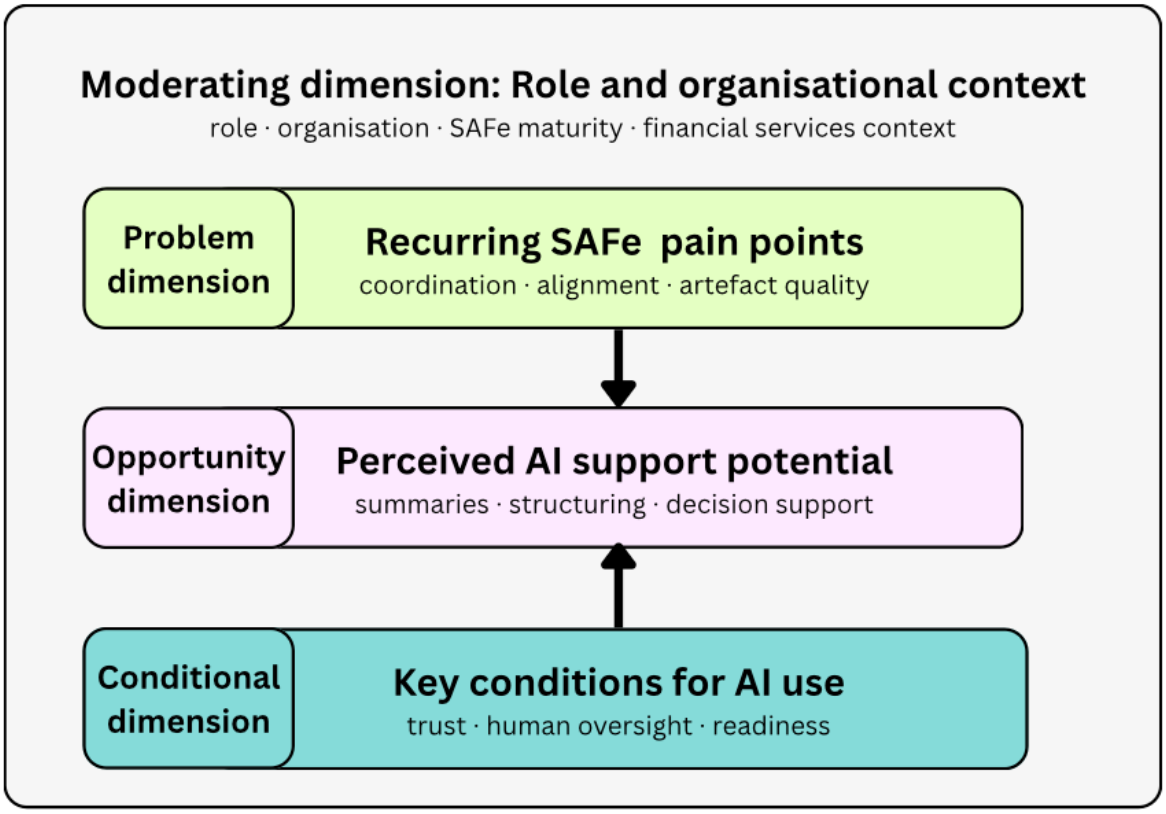
The five findings feed into an operationalized framework that maps recurring SAFe pain points to perceived AI support potential. This potential is conditioned by trust, human oversight, governance, and organisational readiness, and moderated throughout by role and organisational context.
Conclusion
The thesis shows that recurring SAFe challenges are not only process issues. They are deeply connected to organisational structures, role expectations, governance, and the way people collaborate across teams. At the same time, AI is already entering daily work, mostly through individual experimentation rather than coordinated adoption.
The resulting framework offers a practice-grounded starting point for organisations, agile coaches, and decision-makers who want to move from isolated AI use toward meaningful and governed AI integration.