
How Swiss SME's manage Chinese suppliers in a cross-cultural environment

This bachelor's thesis explores how Swiss SMEs navigate the sociocultural complexities of sourcing from China — from supplier selection and relationship-building to risk management. Based on seven qualitative expert interviews analyzed using the Gioia method, the study reveals how cultural competence, relational governance, and platform trust shape sourcing success in practice.
Context and problem statement
China has been one of the most significant procurement markets for Swiss companies for decades. Low production costs, highly specialized industrial clusters and digital sourcing platforms like Alibaba make it structurally attractive — particularly for resource-constrained Swiss SMEs. Yet behind this apparent accessibility lies a complex sociocultural reality: Swiss and Chinese business cultures differ fundamentally in their communication logic, relationship-building approach, and understanding of trust and commitment. In practice, this cultural distance leads to misunderstandings, misaligned expectations, and, in the worst case, failed partnerships with real financial consequences. Despite the significance of this challenge, existing research has barely addressed sociocultural factors in China sourcing from the specific perspective of resource-constrained SMEs.
Research objectives
This thesis examines how sociocultural factors shape the China sourcing activities of Swiss SMEs. Three central research questions guide the investigation: How do sociocultural factors influence the criteria Swiss SMEs prioritize when evaluating and selecting Chinese suppliers? How do Swiss SMEs develop and maintain supplier relationships in China through relational governance practices? And how do they manage sociocultural risks in China sourcing? As a practice-oriented output, a cross-cultural sourcing infographic was developed, visualizing opportunities, challenges, and mitigation strategies across five sourcing phases.
Methodology
The theoretical foundation draws on procurement research, the Relational Governance Model, Hofstede's cultural dimensions, Hall's high-/low-context model, the GlobeSmart profile, and core concepts of Chinese business culture such as Guanxi, Mianzi, and Xinren. The empirical investigation is based on a qualitative-exploratory research design: seven semi-structured expert interviews were conducted with Swiss SME decision-makers and China sourcing experts from German-speaking Switzerland. Data was analyzed using the Gioia method, resulting in a three-stage condensation into First-Order Concepts, Second-Order Themes, and Aggregate Dimensions — prepared in MAXQDA and further processed in Excel.
Findings
The research reveals three central insights.
First, supplier evaluation by Swiss SMEs is not a purely rational process — it is shaped significantly by sociocultural interpretation. Alibaba plays a dual role as a search platform and trust infrastructure: buyer-generated reviews, verification status, and export orientation serve as proxies for quality and cultural compatibility that Swiss SMEs cannot easily verify otherwise. Hard criteria such as price and quality function as minimum thresholds, while the final decision is driven primarily by communicative signals like response speed, proactive service behavior, and English proficiency. Critically, these signals can be misleading: communicative willingness does not automatically translate into delivery reliability, making physical verification through samples and factory visits an essential complement.
Second, Swiss SMEs practice relational governance not as a deliberate strategy but as an intuitive response to the structural conditions of China sourcing. The personal factory visit is identified as the single most effective relationship-building instrument — where not possible, video calls and production videos serve as digital substitutes. Reciprocity governs the relationship: prompt payments, flexibility on complaints, and small gestures of appreciation generate returns over time in the form of better payment terms, free components, and trade fair invitations. Long-term relationships prove more reliable than formal contracts, as the mutual obligation logic of Guanxi discourages opportunistic behavior in ways written agreements cannot replicate in the Chinese context.
Third, risk management among Swiss SMEs is experience-based and situational rather than formalized. The three dominant risks are: limited contract enforceability (a signed contract in China marks the beginning of negotiations, not their conclusion), culturally conditioned non-commitment (polite affirmations are not binding commitments), and deliberate deception practices (including sample substitution and traders posing as manufacturers). These risks are addressed through precise visual specifications, active verification loops, consistent enforcement of minimum requirements, direct contact with factory owners, and leveraging Alibaba's buyer protection mechanism. Across all risk dimensions, cultural competence emerges as the most powerful operational safeguard: those who understand the communicative and cultural logic of Chinese business relationships recognize misunderstandings earlier and make better sourcing decisions.
Practical implications
The findings translate into concrete recommendations for Swiss SMEs, summarized in the cross-cultural sourcing infographic.
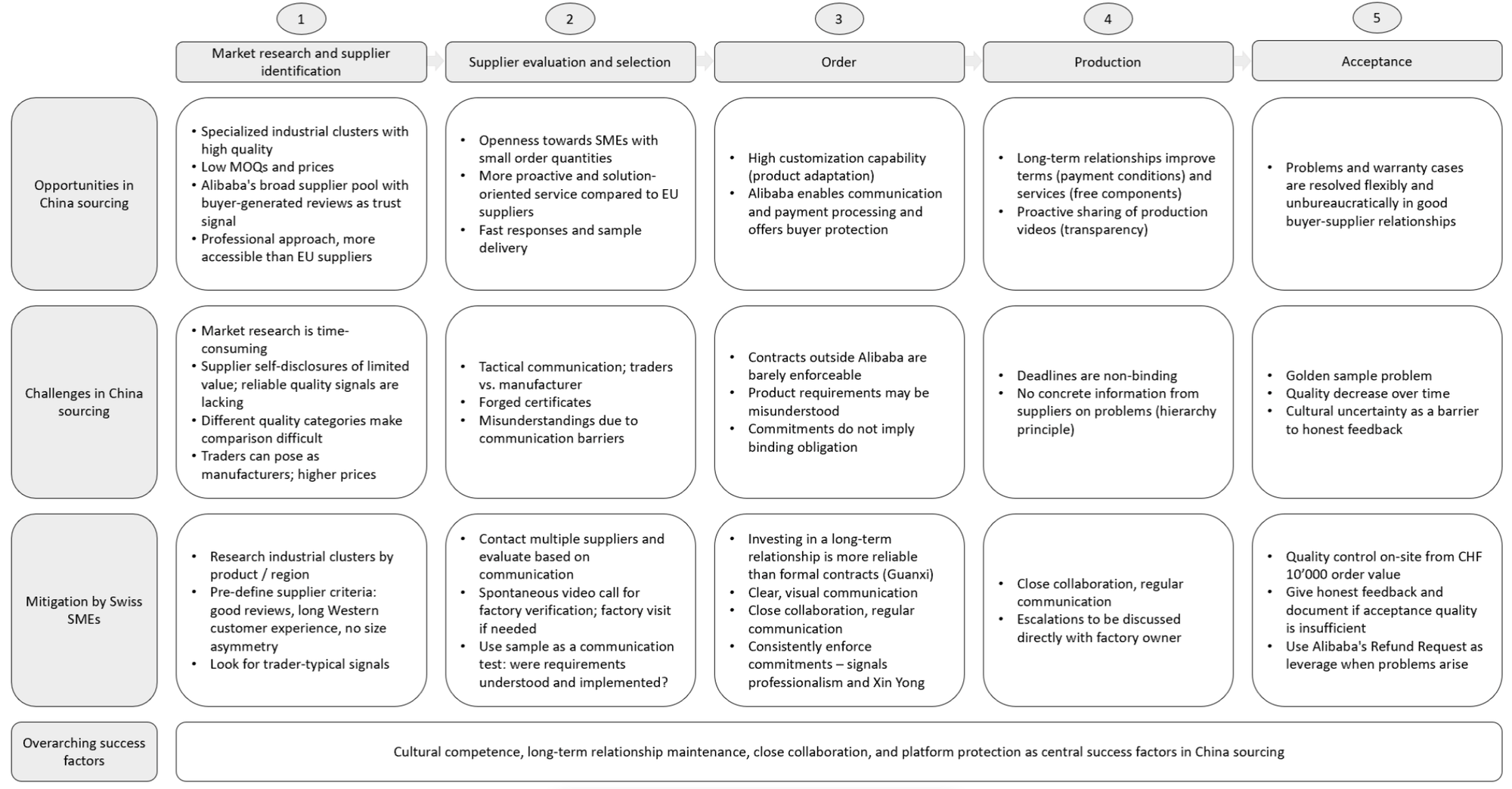
In supplier evaluation: treat communication quality as a standalone criterion, but always verify it physically through samples and factory visits. Prioritize platform reputation, export orientation, and deliberate size-matching as selection criteria.
In relationship-building: invest early in personal closeness through factory visits, culturally attuned gestures, and fast, reliable communication.
In risk management: precise visual documentation, daily check-ins on complex projects, and consistent verification protect more effectively than formal contracts. Understanding the cultural logic behind concepts such as Guanxi, Mianzi, and Xinren is an operational tool that reduces risk and unlocks long-term sourcing success.