
Why Has Brazil Not Used AI in Agribusiness, Despite Being a Global Agricultural Superpower
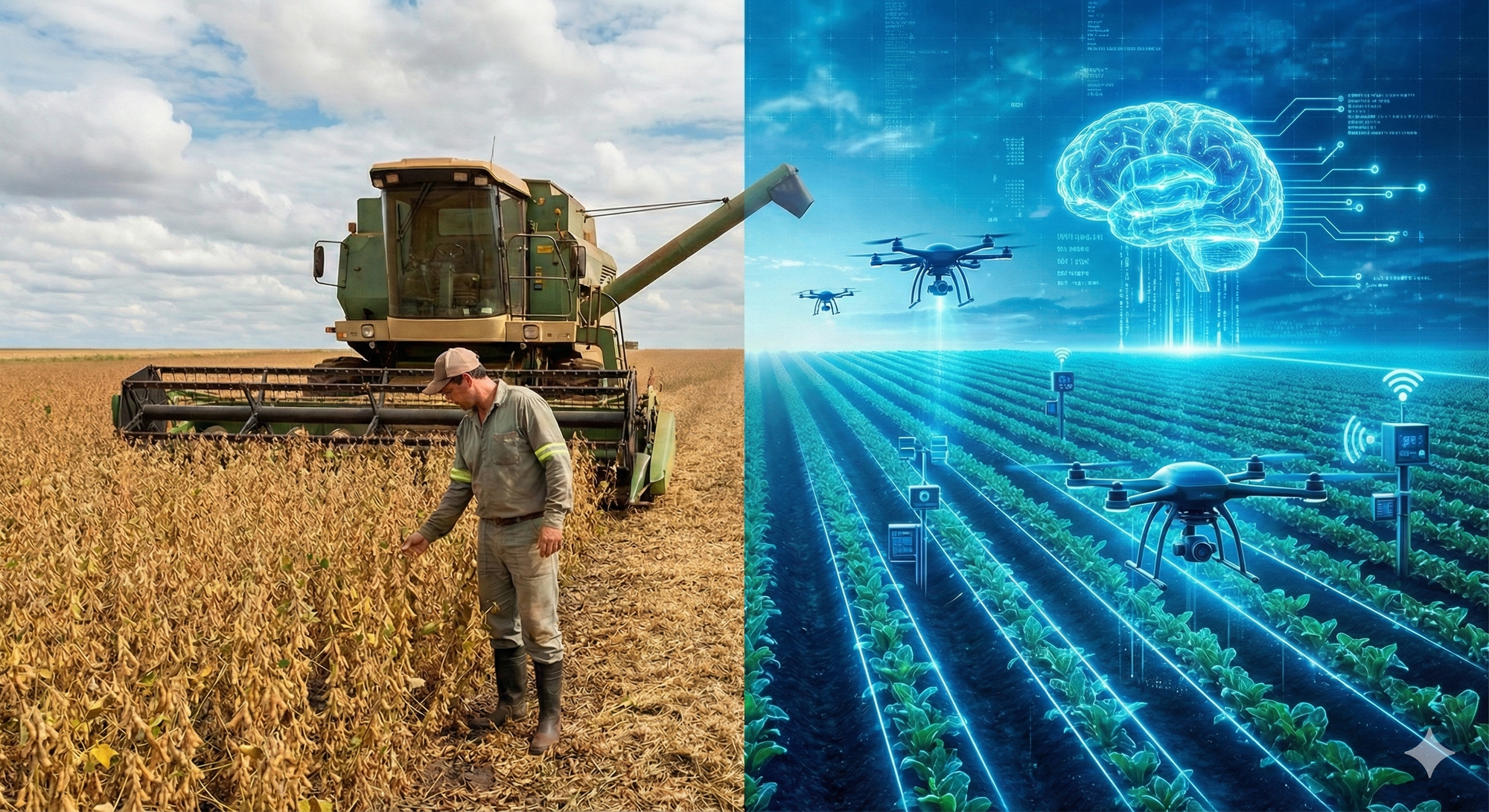
This Bachelor Thesis investigates why Brazil, despite being one of the world’s most dominant agricultural exporters, has not widely adopted Artificial Intelligence (AI) in agribusiness. At the center of the study is the paradox of the “Wealthy Laggard”: highly capitalized large-scale producers in regions such as Mato Grosso who possess the financial capacity for innovation, yet deliberately resist AI-driven technologies. Rather than treating non-adoption as a result of poverty or technological backwardness, the thesis argues that resistance is a rational and strategic response to systemic structural deficits.
The research begins with the observation that Brazilian agribusiness is characterized by high mechanical modernity but low digital maturity. While farmers invest heavily in advanced machinery and precision agriculture tools, AI-based systems such as predictive analytics, cloud platforms, and autonomous decision-making models remain underutilized. This creates a striking contradiction: Brazil generates massive volumes of agronomic data, yet lacks the digital ecosystem to convert this data into scalable intelligence and competitive advantage.
The thesis addresses two central research objectives. First, it examines which economic, institutional, and cognitive barriers prevent large-scale agricultural producers in Brazil from adopting AI. Second, it analyzes how these barriers transform non-adoption into a rational strategy, rather than a passive failure to innovate.
The theoretical framework combines Rogers’ Diffusion of Innovations theory with Williamson’s Transaction Cost Economics. These approaches allow the study to interpret AI adoption not simply as a technological decision, but as a strategic cost-benefit calculation shaped by uncertainty, risk, and institutional voids. Together, they highlight how adoption is influenced by perceived complexity, lack of compatibility, hidden transaction costs, and the absence of trust-building structures.
Methodologically, the thesis follows a qualitative research design based on semi-structured expert interviews (N=6). Experts from EMRAPA, universities, technology providers, and large-scale farming operations were interviewed to triangulate perspectives and uncover the deeper logic behind adoption resistance. The interview data was analyzed through qualitative content analysis, using deductive categories derived from the theoretical framework.
The findings reveal that Brazil’s AI stagnation is not primarily caused by a lack of capital or awareness, but by a complex interaction of systemic obstacles. Key barriers include infrastructural disconnectivity (“Data Paradox”), high hidden implementation costs (“ROI Iceberg”), and an institutional policy vacuum surrounding data sovereignty and legal accountability. In addition, producers experience cognitive friction driven by distrust toward opaque “black box” algorithms and generational succession conflicts within family-run agribusinesses.
The thesis concludes that Brazilian producers should not be understood as technologically conservative laggards, but rather as “Rational Strategic Skeptics.” They postpone AI adoption to avoid absorbing structural risks into private investment decisions. Until rural infrastructure improves, legal frameworks are clarified, and AI systems become more transparent and locally adapted, resisting adoption remains a logical and economically defensible strategy.
From a broader perspective, the research highlights that digital transformation in agriculture is not merely a question of innovation supply, but of ecosystem readiness. For policymakers and technology providers, the key implication is that AI adoption in Brazil will only accelerate if infrastructural investment, regulatory certainty, and trust-building mechanisms are developed simultaneously. Without these foundations, Brazil risks remaining an agricultural superpower with untapped digital potential.